
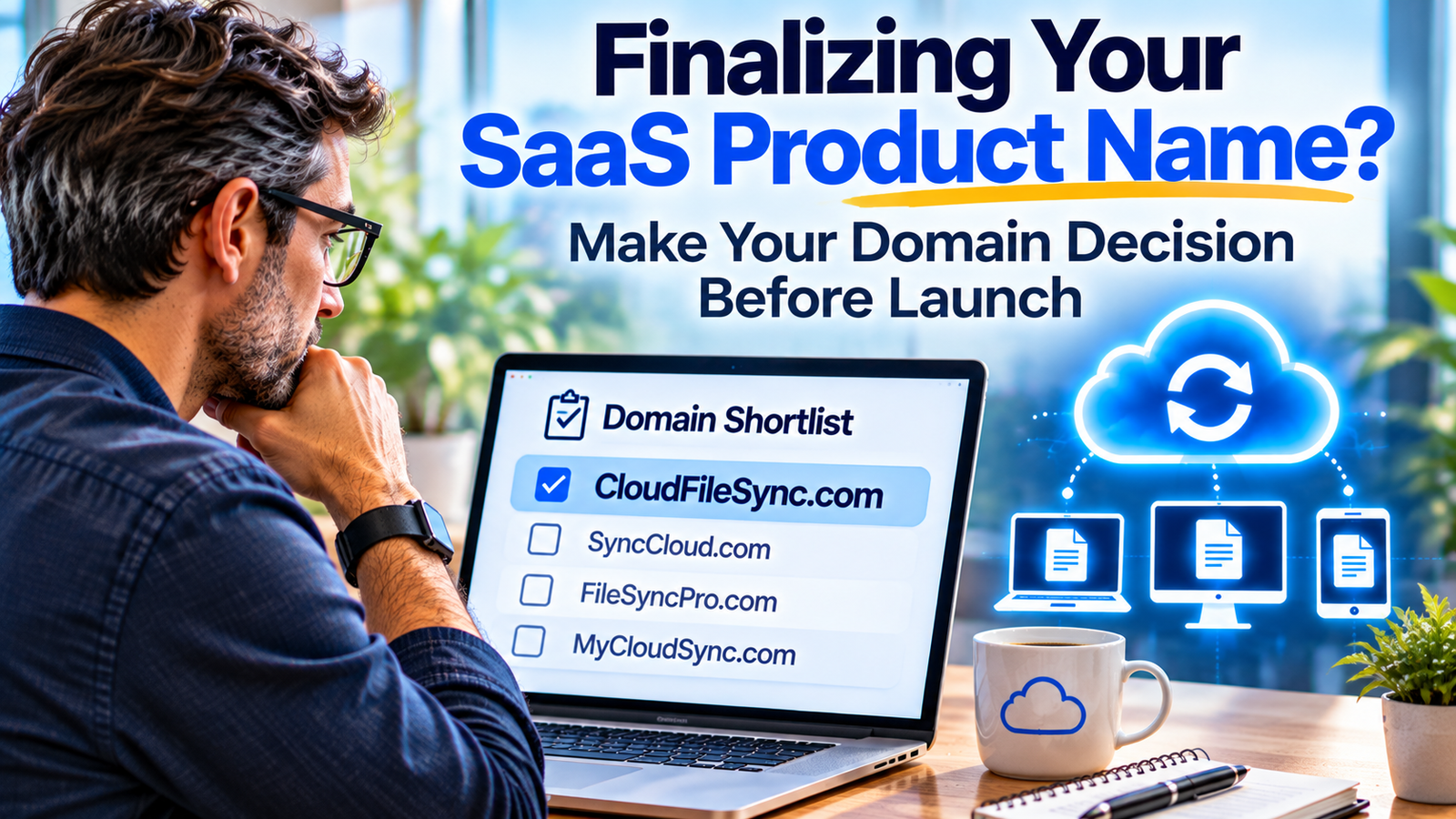
Finalizing Your SaaS Product Name? Why CloudFileSync.com Deserves a Place on Your Shortlist
Before launching your cloud file synchronization application, make sure the domain you choose fits the product you’re preparing to introduce.
You’ve spent time developing your cloud file synchronization application. Perhaps you’ve been refining the software, planning its features, or preparing the materials you’ll use to introduce it to potential users.
Now you’re approaching another important decision: choosing the name that will represent your product.
You’ve probably considered several possibilities. Some may be invented brand names. Others may describe what your software actually does.
You’ve narrowed the list, and you’re getting closer to making a final choice.
At this stage, domain selection is no longer simply a creative exercise. It’s a practical decision that affects how you’ll present your application when it becomes publicly available.
For founders building cloud file synchronization software, CloudFileSync.com is one descriptive .com domain worth evaluating.
Currently listed for sale through GoDaddy/Afternic at $2,295, it combines three recognizable technology terms that directly relate to the intended software category.
But before choosing any domain, it’s worth considering what makes a name appropriate for your product.
1. The Final Naming Decision Is Different From Early Brainstorming
During the early stages of developing a SaaS application, naming ideas may come and go.
You might experiment with different combinations of words, create invented names, or use a temporary working title while concentrating on the software itself.
At that point, you aren’t necessarily committed to any particular identity.
But as the project approaches launch, the situation changes.
You’re preparing to establish a public-facing product.
You may need a website address for a landing page, product descriptions, demonstrations, or communications with prospective users.
This creates a more immediate need to select a domain.
Instead of asking, “What are some interesting names for my application?” you’re asking:
“Which of these names should become the permanent address for my product?”
That shift matters because you’re evaluating actual purchasing options rather than collecting ideas.
The goal is to choose a domain that aligns with your software, branding preferences, and launch plans.
2. Begin by Defining What Your SaaS Application Does
Before comparing names, clarify the primary purpose of your application.
Is your software focused on synchronizing files through cloud-based technology?
Will it provide a dedicated file synchronization service?
Are you developing a cloud file management application where synchronization is the central function?
Or is file synchronization only one component of a much broader platform?
These distinctions can influence the type of domain that makes sense.
A specialized application may benefit from a name that describes its function.
A broader software platform might require a name that leaves room for several different services.
For a project centered specifically on cloud file synchronization, a descriptive domain can be particularly relevant.
CloudFileSync.com follows that approach.
Its wording connects directly to the category of software a founder may be preparing to launch.
That doesn’t automatically make it the right choice for every application, but it establishes a clear reason to consider it.
3. Descriptive Names Versus Invented SaaS Brands
One of the central decisions in SaaS naming is whether to choose an invented brand or a descriptive name.
Both approaches have advantages.
Invented Brand Names
An invented name can provide a distinctive identity that isn’t necessarily tied to one software function.
This may be appropriate for a business planning to expand into multiple product categories.
However, the name itself may not immediately communicate what the application does.
The company may need to explain the relationship between its brand and its software.
Descriptive Domain Names
A descriptive domain uses recognizable words associated with the intended product or service.
For a specialized application, this approach may appeal to founders who want the name to reflect the software’s purpose.
Consider the structure of CloudFileSync.com:
Cloud refers to cloud-based technology.
File identifies the digital content involved.
Sync refers to synchronization.
Together, these three words describe a recognizable technology function.
The name doesn’t require someone to interpret an invented term to understand its general subject.
Of course, a descriptive name isn’t automatically more memorable, commercially valuable, or successful than an invented brand.
The decision depends on the identity you want to establish.
4. Evaluate How the Domain Will Look in Your Launch Materials
A domain name doesn’t exist only in a browser address bar.
Once your application becomes public, you may use the domain in several different contexts.
It might appear on your product website, in software demonstrations, within documentation, or in communications with potential users.
This makes it useful to consider how each shortlisted domain will function in everyday business situations.
Imagine introducing your application in a presentation.
You explain that your software is designed around cloud file synchronization.
Then you display the website address.
Does the name support the description you’ve just provided?
Could it serve comfortably as the address for your product’s landing page?
Would you be satisfied using it consistently throughout your launch materials?
For a cloud file synchronization project, CloudFileSync.com offers a straightforward connection between the name and the intended software category.
That relationship may be valuable to a founder who prefers descriptive branding.
5. Consider Whether the Name Fits Your Longer-Term Direction
Even when you’re approaching launch, it’s worth thinking beyond the initial release.
Your application may develop additional capabilities over time.
The question is whether the domain will continue to represent the product’s central purpose.
If cloud file synchronization remains the primary focus, a descriptive domain like CloudFileSync.com may continue to align with the application.
However, if your plans involve expanding into unrelated software categories, a more general name may offer greater flexibility.
This isn’t a reason to avoid descriptive domains.
It’s a reason to evaluate them against your intended direction.
When you’re comparing a final shortlist, consider not only the application you’re launching today but also the type of product identity you want to maintain.
6. Why the .com Extension May Influence Your Decision
Domain extensions are another part of the naming process.
Some SaaS companies use extensions associated with technology or software.
Others prefer the familiar .com extension.
CloudFileSync.com combines its descriptive wording with .com.
For founders who want a conventional website address, that may be a positive consideration.
However, the extension itself doesn’t guarantee website traffic, search rankings, customer trust, or commercial success.
Those outcomes depend on other factors.
The practical question is whether the complete domain, including its extension, fits your branding preferences.
If .com is one of your priorities, CloudFileSync.com provides an option to evaluate.
7. Compare Your Final Domain Candidates Systematically
When you’re close to making a decision, it helps to evaluate each domain using consistent criteria.
Rather than choosing based entirely on personal preference, consider several practical questions.
Product relevance: Does the name align with your application’s primary purpose?
Clarity: Does the wording communicate a recognizable concept?
Branding suitability: Does the name fit the identity you want to establish?
Future direction: Will the domain remain appropriate as your application develops?
Extension: Does the complete website address meet your preferences?
Acquisition cost: Does the asking price fit your available budget?
CloudFileSync.com can be evaluated against these same questions.
Its most obvious characteristic is its descriptive relationship to cloud file synchronization.
Its .com extension may appeal to founders who prefer that format.
And its listed asking price provides a specific figure for budget comparisons.
Other candidates may offer different advantages, including broader naming flexibility or lower acquisition costs.
The objective is to identify which domain best supports your particular project.
8. What Does Purchasing CloudFileSync.com Include?
Before making a final decision, understand exactly what you’re purchasing.
CloudFileSync.com is offered as a domain name.
The purchase is not presented as including a functioning cloud synchronization application, existing customers, an established software business, or developed technology.
If you acquire the domain, you’ll still need to build, operate, and promote your software.
The domain provides a potential website address and product identity.
This distinction matters because the name may describe a software function, but the domain itself doesn’t perform that function.
Your purchasing decision should therefore focus on the suitability of the domain for your proposed application.
9. Review the Asking Price and Complete Your Due Diligence
CloudFileSync.com is listed for sale through GoDaddy/Afternic at an asking price of $2,295.
For a founder preparing to select a permanent domain, that provides a concrete purchasing option.
Whether the price is appropriate depends on your budget, priorities, and alternatives.
The asking price isn’t an independently established appraisal or a guarantee of future value.
Before purchasing any existing domain, consider reviewing its history, investigating possible trademark issues, and understanding the marketplace’s current transaction and transfer terms.
You should also verify the listing and price before proceeding.
These steps help ensure that your final decision is based on more than the appeal of the name.
10. Is CloudFileSync.com the Right Choice for Your SaaS Project?
If you’re developing a cloud file synchronization application and approaching your final naming decision, CloudFileSync.com may deserve a place on your shortlist.
Its three descriptive components connect directly to the software category.
Its .com extension provides a familiar website address.
And its $2,295 asking price gives you a specific amount to evaluate against your acquisition budget.
The domain could potentially suit a dedicated cloud file synchronization application, a related SaaS product, or a cloud file management service in which synchronization is central.
These are potential uses, not existing software or services included in the purchase.
Ultimately, the right domain depends on what you’re building and how you want to present it.
11. Ready to Finalize Your SaaS Product Name?
Choosing a domain is one of the practical decisions involved in preparing a software application for public launch.
Once you’ve narrowed your naming options, the goal is to select an address that supports your product identity and fits your business plans.
If your application focuses on cloud file synchronization, consider whether CloudFileSync.com belongs on your final shortlist.
CloudFileSync.com is currently listed for sale through GoDaddy/Afternic for $2,295.
To investigate the opportunity, search for CloudFileSync.com on GoDaddy or Afternic and review the current listing and purchase terms.
Compare it with your other candidates, evaluate its suitability, and make the choice that best aligns with your software.
Your application represents the technology you’re developing. Your domain name helps establish how you’ll introduce it to the world.