
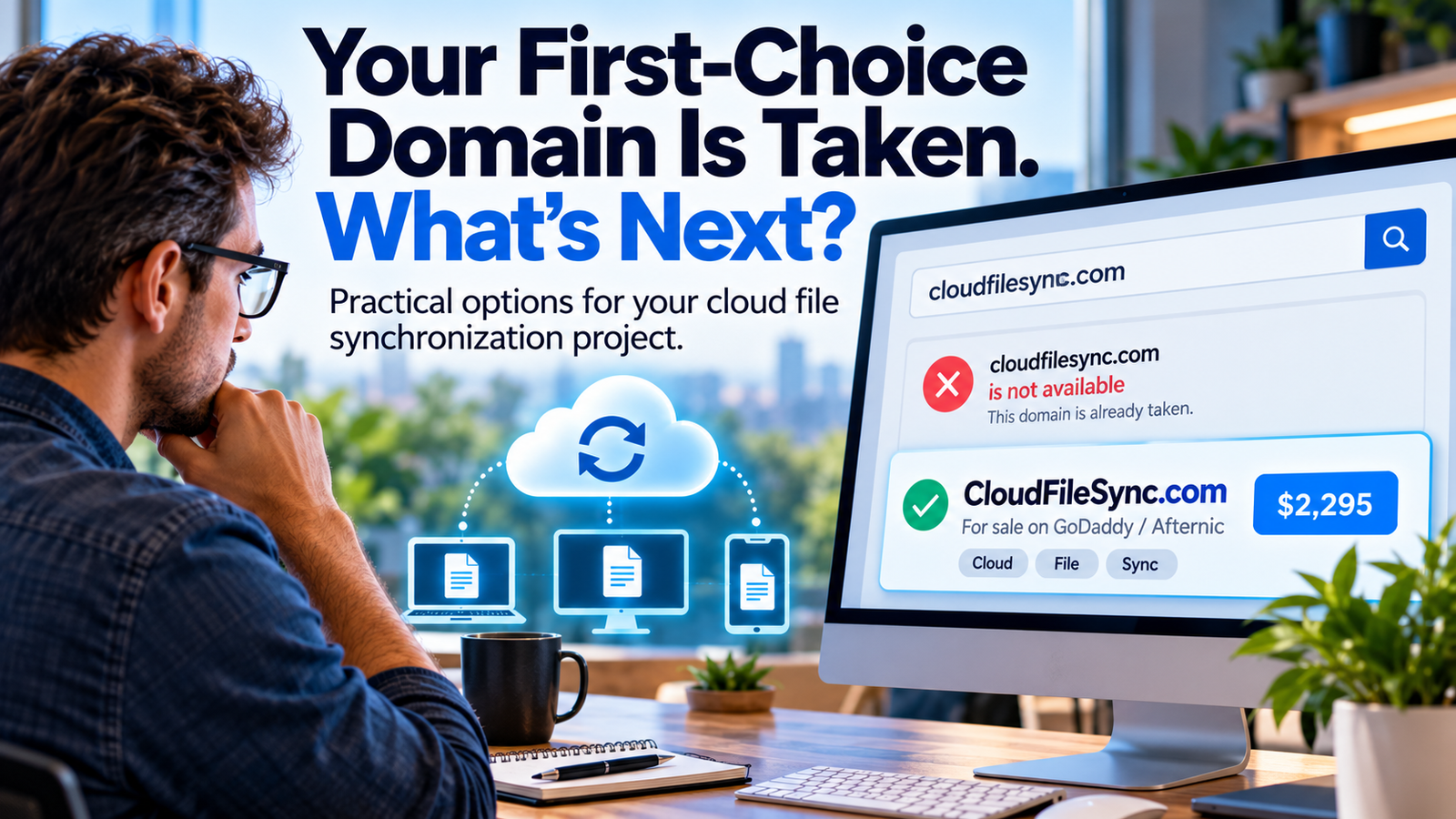
How to evaluate alternative domain names when you’re preparing to launch a cloud file synchronization business or application.
You’ve developed an idea for a cloud file synchronization application. You’ve thought about what the software will do, how it might serve users, and how you want to present it to the market.
Perhaps you’ve even settled on a name.
Then you search for the corresponding domain—and discover that it isn’t available for ordinary registration.
Now what?
For entrepreneurs, developers, and software founders, this can become an important decision point. Your preferred name may no longer be a straightforward registration option, but that doesn’t necessarily mean you need to abandon your original branding direction.
You have several possible paths, including modifying the name, choosing another domain extension, or investigating domains already owned and offered for resale.
If you’re developing a product related to cloud file synchronization, one existing domain worth considering is CloudFileSync.com, currently listed for sale through GoDaddy/Afternic.
Before making a decision, however, it’s useful to understand your options and what each could mean for your project.
1. When Your First-Choice Domain Isn’t Available
Finding that a preferred domain is unavailable for ordinary registration can change the direction of a naming decision.
Until that moment, you may have been thinking primarily about what you wanted to call your product.
Now you’re considering what you can actually acquire.
The distinction matters.
A domain that isn’t available for ordinary registration may already be owned by someone else. Depending on the circumstances, it might be in use, held for a future project, or offered for resale.
Importantly, unavailable for ordinary registration does not necessarily mean unavailable for purchase.
This is where domain resale marketplaces become relevant.
Rather than continuing to search exclusively for names available at standard registration prices, you may decide to evaluate existing domains that their owners have listed for sale.
For a cloud synchronization startup, this creates an opportunity to reconsider which qualities matter most in a domain name.
2. Three Options When Your Preferred Domain Is Unavailable
When your first choice doesn’t work out, there are three broad approaches worth evaluating.
Option One: Modify Your Original Name
You might add another word, adjust the wording, or choose a variation of the name you originally preferred.
This approach allows you to preserve some of your initial branding concept.
However, every variation deserves its own evaluation.
Does the modified name still describe your application? Is it appropriate for the product identity you want to establish? Does it introduce unnecessary complexity?
A variation that is available for registration isn’t automatically a better choice than an existing domain offered for sale.
Option Two: Choose Another Domain Extension
Another possibility is to keep your preferred wording while exploring extensions other than .com.
Different extensions may suit different branding strategies.
The important consideration is whether the complete address aligns with how you intend to present your business or application.
For some developers, an alternative extension may be perfectly appropriate.
Others may prefer a .com address because it is familiar and fits their intended product identity.
Neither choice guarantees better business performance. The decision should reflect your branding preferences, available options, and budget.
Option Three: Consider an Existing Domain Offered for Sale
You can also investigate domains already registered and listed for resale.
This approach may allow you to consider wording that isn’t available through ordinary registration.
However, purchasing an existing domain generally involves a different financial decision from registering a new one.
You’ll need to evaluate the asking price, the suitability of the name, and the applicable marketplace transaction terms.
For a developer preparing a cloud file synchronization product, CloudFileSync.com is an example of this third option.
3. Why a Descriptive Domain Might Be Worth Considering
When searching for an alternative name, it’s tempting to focus entirely on availability.
But availability is only one consideration.
The domain should also fit what you’re building.
Suppose your proposed software focuses on synchronizing files through cloud-based technology.
You could choose an invented name that establishes a distinctive brand identity. Alternatively, you could choose a descriptive name that directly communicates the product category.
Both approaches have potential advantages.
A descriptive domain uses recognizable words to suggest what the associated product or service is about.
Consider the three components of CloudFileSync.com:
Cloud: Connects the name to cloud-based technology.
File: Identifies the digital content involved.
Sync: Refers to synchronization.
Together, these words describe a recognizable technology function.
For a product specifically focused on cloud file synchronization, that direct connection may be appealing.
Of course, a descriptive domain doesn’t automatically generate website traffic, improve search rankings, or establish a successful business.
Its primary contribution is to provide a website address and potential product identity that align with the intended service.
4. Consider What You’re Actually Planning to Launch
Before selecting an alternative domain, think carefully about the scope of your proposed application.
Is cloud file synchronization the primary service?
Are you creating a standalone synchronization tool?
Will the application be part of a broader cloud storage platform?
Are you developing a specialized file management service?
These questions can help determine whether a descriptive domain is appropriate.
If your project is centered on cloud file synchronization, a name like CloudFileSync.com may fit naturally.
If your long-term plans involve many unrelated software categories, you may prefer a broader identity.
The goal isn’t simply to acquire an attractive domain.
It’s to choose one that supports the direction of your project.
That distinction becomes particularly important when considering a domain listed for resale, because you’re making a purchase decision rather than merely experimenting with possible names.
5. When Does Purchasing a Resale Domain Make Sense?
An existing domain offered for sale may deserve consideration when several conditions align.
First, the wording should fit the product or business you’re developing.
Second, the domain should support your intended public identity.
Third, the asking price should be reasonable within your own project budget.
And fourth, you should understand what the purchase includes.
For CloudFileSync.com, the offering is the domain name itself.
It is not being presented as a functioning cloud synchronization application, an existing software business, or a package containing developed technology.
That distinction is essential.
If you purchase the domain for a software project, you’ll still be responsible for developing, operating, and promoting the application.
The domain provides a possible public address for that work.
This is why evaluating a resale domain should involve more than asking whether the name sounds appealing.
You should consider how the purchase fits your actual launch plans.
6. Introducing CloudFileSync.com as an Alternative
If your original domain choice hasn’t worked out, CloudFileSync.com may be worth adding to your shortlist.
The domain combines three familiar technology terms in a .com address.
Its descriptive wording makes it potentially relevant to several kinds of projects, including:
- A cloud file synchronization application.
- A SaaS product centered on file syncing.
- A dedicated cloud synchronization service.
- A cloud-based file management project in which synchronization is a central function.
These are potential applications for the name, not existing products or features included with its purchase.
CloudFileSync.com is currently listed for sale through GoDaddy/Afternic at an asking price of $2,295.
For a buyer who wants a descriptive .com domain associated with cloud file synchronization, the listing provides a specific option to investigate.
Whether it’s the right choice depends on the proposed product, branding preferences, and budget.
7. How to Evaluate CloudFileSync.com Before Buying
If the name interests you, consider a short evaluation before making a purchase decision.
Does the name match your intended product?
CloudFileSync.com is most directly relevant to projects where cloud file synchronization is a central concept.
Think about whether that description accurately reflects the service you intend to launch.
Do you prefer a descriptive name?
Some businesses prefer invented names that can develop their own associations over time.
Others want their domain to communicate the general product category.
CloudFileSync.com follows the descriptive approach.
Does the .com extension fit your plans?
The extension is familiar and can serve as the address for many types of websites.
Consider whether it aligns with the identity you want to establish.
Is the asking price appropriate for your project?
At $2,295, the domain represents a specific expenditure within your broader launch budget.
Compare that cost with your other priorities, including application development, website creation, and ongoing operations.
The asking price is a listing price, not a guarantee of future value.
Have you completed your own due diligence?
Before acquiring any existing domain, consider checking its history, potential trademark issues, and applicable marketplace terms.
You should also confirm the current listing details before proceeding.
These steps can help you evaluate the domain as a practical business purchase.
8. Don’t Let Your First Domain Choice Determine Your Entire Project
Discovering that your preferred domain isn’t available can be disappointing, especially when you’ve already invested time in selecting a name.
But the situation also provides an opportunity to reconsider your priorities.
Perhaps your original name was appealing because it was short.
Perhaps you liked its connection to your application’s purpose.
Or perhaps you simply wanted a domain that would be straightforward to use when introducing the product.
Identifying what mattered about the original choice can help you evaluate alternatives more effectively.
For a cloud file synchronization application, descriptive relevance may be one of those priorities.
In that case, CloudFileSync.com deserves consideration alongside other naming options.
The important point is to avoid treating your original choice as the only possible path forward.
A domain should support the project—not determine whether the project can proceed.
9. Ready to Explore an Existing Cloud Sync Domain?
If you’re preparing to launch a cloud file synchronization application and your preferred domain isn’t available for ordinary registration, consider whether an existing domain offered for sale might better fit your plans.
CloudFileSync.com is a descriptive .com domain that directly reflects the cloud file synchronization category.
It is listed through GoDaddy/Afternic with an asking price of $2,295.
To investigate the opportunity, search for CloudFileSync.com on GoDaddy or Afternic and review the current listing and purchase details. Alternatively, you can just type the URL into a search, and you’ll be taken directly to the sales page.
You don’t have to choose a domain simply because it’s available for ordinary registration.
You can also evaluate whether an existing domain for sale offers wording that better aligns with the product you’re preparing to build.
Your first-choice domain may not be an option. But your next choice can still be a thoughtful one.