
When most people hear about domain investing, they immediately think of the big success stories.
Someone buys a domain name for $10 and sells it for $10,000.
Or $100,000.
Or even more.
Those stories are real.
But they only tell part of the story.
Over the past few years, I’ve built a portfolio of more than 390 domain names. Along the way, I’ve learned a few lessons that aren’t always discussed in domain investing circles.
Domains Are Digital Real Estate
At its core, domain investing is simple.
You acquire domain names that you believe may have future value to businesses, organizations, entrepreneurs, or content creators.
Some domains are valuable because they describe products or services.
Others are valuable because they are memorable brands.
Still others are valuable because they attract search traffic or communicate authority in a particular niche.
The appeal is easy to understand. A domain can be purchased for a relatively small amount and potentially sold later for a much higher price.
But that brings us to the first challenge.
Domains Are Not Highly Liquid
One of the biggest misconceptions about domain investing is that domains can be sold quickly whenever cash is needed.
In reality, domains often behave more like real estate than inventory.
You may own a valuable domain, but you still need the right buyer at the right time.
A domain that is worth $2,000 or $5,000 on paper may not sell this week, this month, or even this year.
That doesn’t mean the domain lacks value. It simply means the market hasn’t matched you with the right buyer yet.
Liquidity is one of the most important concepts new investors need to understand.
Renewal Costs Are Real
Another lesson is that every domain carries an ongoing cost.
A portfolio of a few domains is easy to manage.
A portfolio of hundreds of domains is a different story.
As portfolios grow, annual renewal fees can become substantial. Investors must continually evaluate whether each domain still justifies its place in the portfolio.
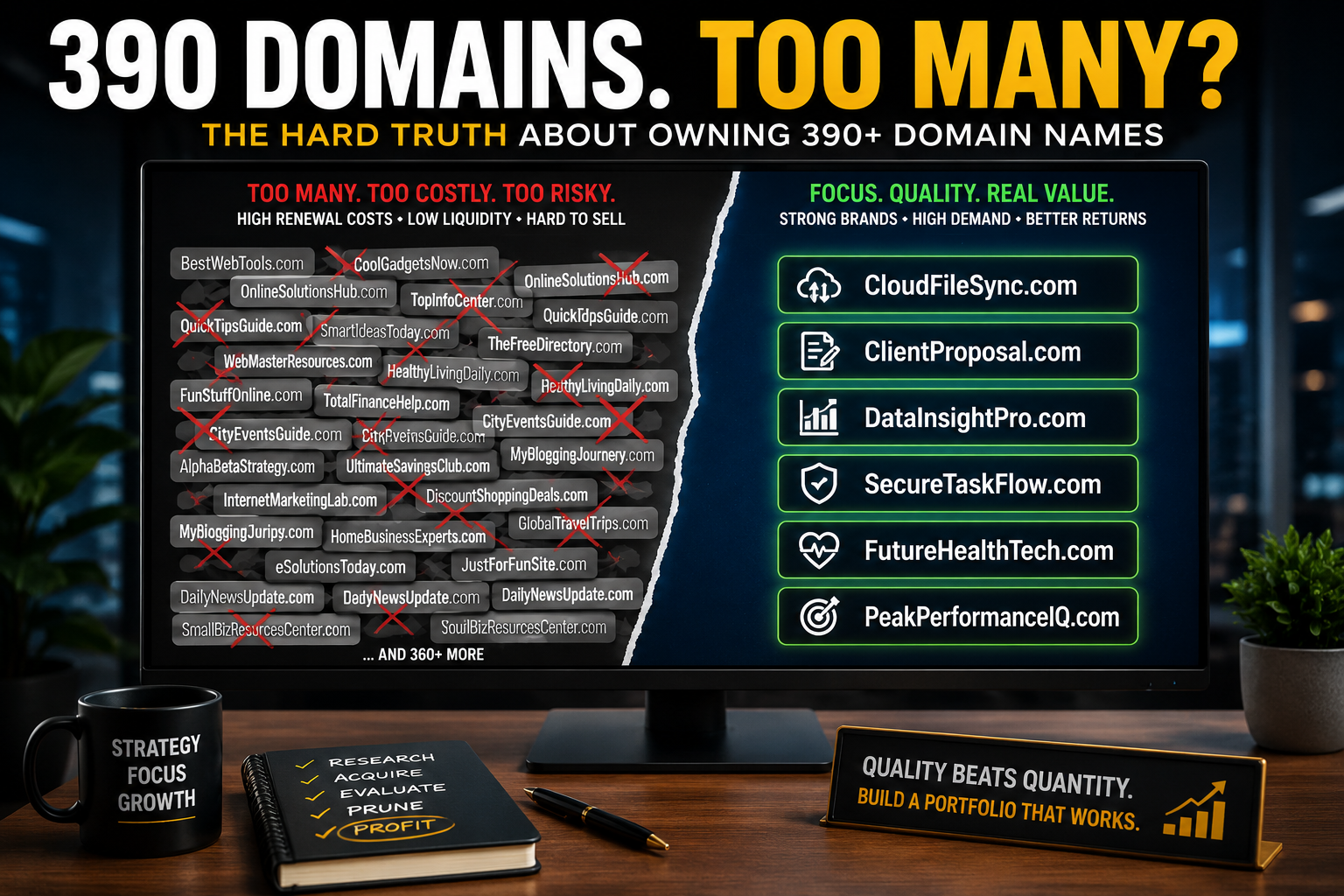
Recently, I began a major review of my own holdings and realized that quality matters far more than quantity.
A smaller portfolio of strong domains may outperform a much larger portfolio filled with marginal names.
What Makes a Domain Valuable?
There is no perfect formula, but several characteristics tend to increase value.
Strong domains are often:
- Easy to remember
- Easy to spell
- Commercially useful
- Relevant to a specific market
- Built on the .com extension
For example, a business-oriented name such as ClientProposal.com immediately suggests practical use cases.
A technology-focused name such as CloudFileSync.com speaks directly to a specific industry.
The best domains often communicate value immediately.
Selling Domains Is a Skill
Buying domains is only half of the equation.
Learning how to market, price, and sell them is equally important.
Many investors simply list domains and wait.
Others actively contact potential buyers, build landing pages, create content, and develop sales strategies.
I’ve spent considerable time learning this side of the business and recently recorded a video showing exactly how I list domains for sale using GoDaddy and Afternic.
The video covers:
- Pricing strategies
- Buy It Now listings
- Minimum offers
- For-sale landing pages
- Wholesale versus retail pricing
- Lease-to-own options
If you’re curious about domain investing or have domains you’d like to sell, I think you’ll find it helpful.
The Bottom Line
The biggest lesson I’ve learned from owning more than 390 domain names is surprisingly simple:
Quality beats quantity.
The goal is not to own the most domains.
The goal is to own domains that someone will genuinely want to buy.
Domain investing remains a fascinating business. It combines entrepreneurship, marketing, creativity, and long-term thinking in a unique way.
But like any business, success often comes from focusing on the fundamentals, making thoughtful decisions, and continuously refining your strategy.
That’s exactly what I’m working on today.